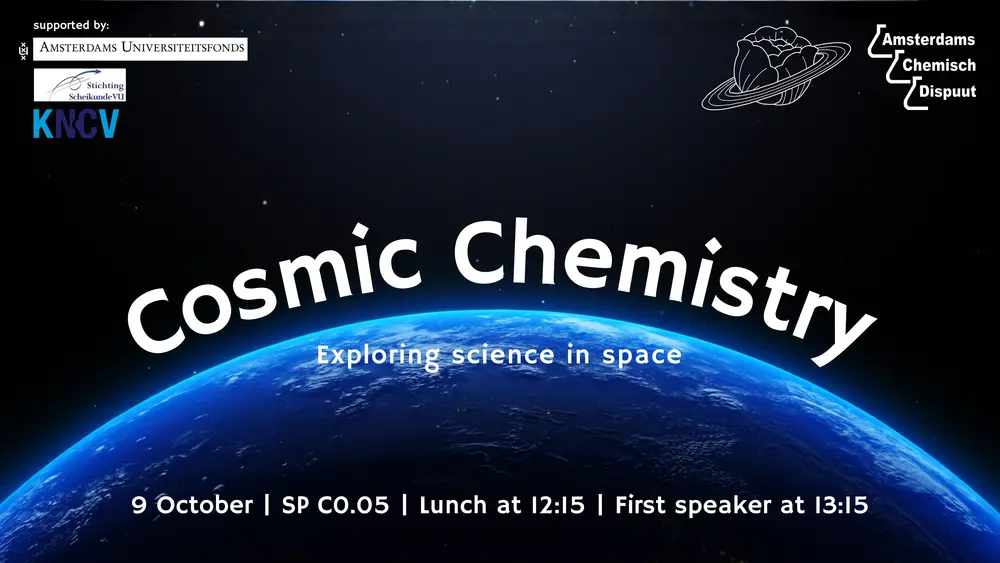
The ACD’s anniversary is slowly approaching, which means this 16th lustrum year full of festivities is almost coming to an end. But don’t worry, the lustrum committee is organizing one final event: the lustrum symposium! Take a journey through the stars with lectures by some of the stars in astrochemistry.
Add the symposium to your calendar!
You can sign up for the free lunch at the bottom of this page.
About the speakers
Prof. dr. Herma Cuppen
Surface astrochemistry - how complex can it be?
The interstellar medium is far from empty, but consists of dust and gas with a surprisingly rich chemistry. Despite its low temperature and low pressure, many new molecules can form and these molecules play an important role in the formation of new stars and planets. Many `terrestrial' molecules like water, methanol, and carbon dioxide form through surface reactions on interstellar dust particles, building up ice layers. In the past years, research has focused on a better understanding of surface astrochemistry. This was initially on the formation of small molecules, but recently also larger molecules like glycolaldehyde and glycine were considered. Both molecules can form at 10K without the presence of light, contrary to what was initially thought. Ultimately, these molecules end up in comets and other building blocks of our Solar System. Prof. dr. Herma Cuppen will discuss how we study these ice layers in the laboratory, by simulations, astronomical observations and models.
Prof. dr. Michiel Hogerheijde
Following the path of molecules from interstellar space to forming planets
When interstellar clouds collapse, they form stars surrounded by rotating disks of gas and dust. The molecules that were present in the cloud now find themselves in an environment with unique properties: cold and dense midplanes, disk surfaces that are irradiated by stellar ultraviolet photons and X-rays, and inner disks close to the star with temperatures up to hundred or even thousands of degrees. This has a strong impact on the chemical composition of the material, both in the gas and in icy mantles that freeze out on miniscule dust grains. Prof. dr. Michiel Hogerheijde will discuss what chemical evolution takes place as planets grow inside these disks, how this affects the future composition of these planets and their atmopsheres and oceans, and how this process is studied with the largest telescopes on Earth and in space.
Dr. Alessandra Candian
From the stables to the stars: the special role of aromatic molecules in space
Polycyclic aromatic hydrocarbons (PAHs) are familiar to chemists as persistent combustion products and environmental pollutants. Yet these same aromatic molecules are also among the most abundant carbon-containing species in the Universe.
PAHs are found in regions where stars and planets are born, in the diffuse material between stars, and even in bodies within our Solar System, such as Saturn’s moon Titan. Their presence strongly influences the physical properties of these different environments (temperature, electron density) and also the chemistry that can take place there.
In this lecture, dr. Alessandra Candian will give an overview of what we think we understand of the lifecycle of these molecules, what are the current challenges and how current and future telescope can help solve them.
Prof. dr. Maarten Krol
Our atmosphere seen from space
The Earth atmosphere plays a vital role in the livability of our planet. Without the atmosphere, our climate would be vastly different, humans and plants could not live, and the sky would not be blue.
Nevertheless, little is done to safeguard a healthy atmosphere. Due to human activity, greenhouse gas concentrations rise, which threatens our climate, and pollutants are emitted, which harms our health and the health of ecosystems.
Looking from space, satellites instruments provide perfect tools to observe these changes in the atmosphere and hopefully provide the measurements that will trigger policy that will mitigate large-scale atmospheric change.
In his lecture, prof. dr. Maarten Krol will give an overview of past and future activities in atmospheric remote sensing. Specifically, I will address the physical principles that enable observations from space and highlight current and upcoming applications, including methane leak detection from space, and monitoring stack emissions from space.
Tickets
When
12:15 - 17:00
Where
1098XH Amsterdam